10.2.2026
Why an ADA-Compliant Reception Desk Can Fail in California
This is the default text value
This is the default text value
This is the default text value
,
This is the default text value
This is the default text value
Lorem ipsum dolor sit amet, consectetur adipiscing elit. Suspendisse varius enim in eros elementum tristique. Duis cursus, mi quis viverra ornare, eros dolor interdum nulla, ut commodo diam libero vitae erat.
Default Button Text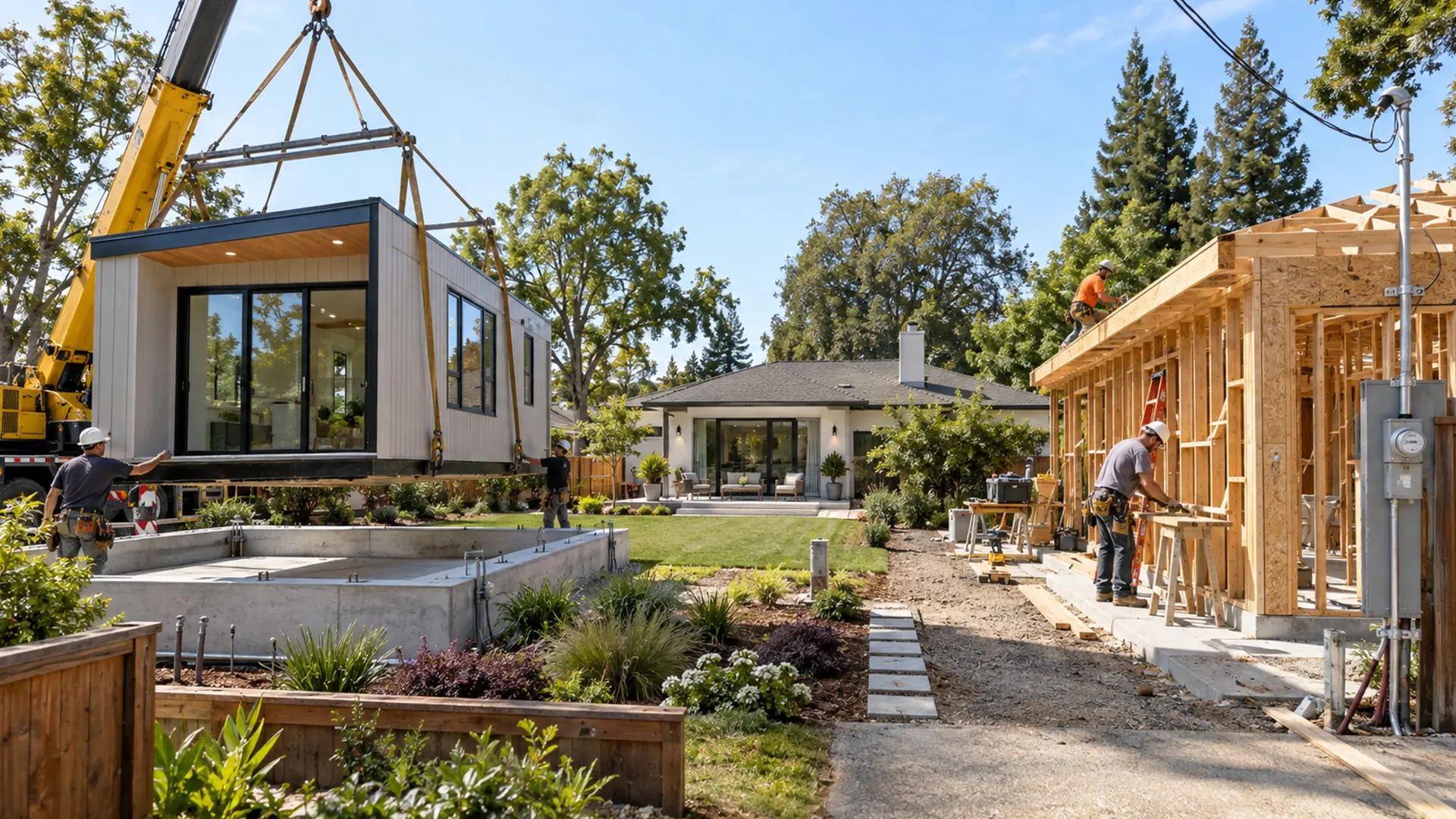
A factory can be building your accessory dwelling unit (ADU) while the application to power it is still waiting in line. In PG&E territory, new electric service for an ADU averaged 303 days from application to energized, based on PG&E's own published data. A finished unit set on a finished foundation still can't be lived in without power.
That's the problem with asking whether prefab or custom is better. The build method changes how the walls get made. It doesn't change your lot, your utility, or your city's inspections. Those decide most of your schedule and a good share of your cost.
We design and build custom ADUs, so you should read this knowing that. But there are lots where a factory-built unit is the right choice, and we'll tell you which ones. There's also one question that matters more than speed or price: when a factory builds part of your ADU and a contractor builds the rest, who answers for the handoff between them?
"Prefab" covers four different ways of building an ADU. They behave very differently on a real lot.
Whole room-sized sections are built and finished in a factory. They're trucked to your property and set on a foundation with a crane. Most of the building arrives done.
Walls, floors, or roof sections are built in a factory and shipped flat. A crew assembles them on site. Much more of the work still happens in your yard.
A complete home is built on a steel chassis under federal manufactured-housing standards. It goes on a permanent foundation at your property. This is a detached-only option.
A package of pre-cut or pre-made parts is delivered for a crew to assemble. In practice, most of the construction is still done on site.
You'll also see "preapproved plans" offered as a shortcut. A preapproved plan isn't a way of building. It's a design your city has already reviewed, and it can shorten plan review for a detached ADU. It can be built with a site-built crew or with panels. Our Q&A guide to California ADU rules covers the permit basics.
No. A factory-built ADU moves part of the review to the state. Everything that happens on your property stays with your city or county.
For factory-built housing, the California Department of Housing and Community Development (HCD) certifies private agencies to do the factory side. A design approval agency reviews the unit's plans. A quality assurance agency inspects the unit while it's being built. Each approved unit carries an HCD insignia that tells your local building department the factory work was inspected.
Your local building department still reviews zoning and the site plan. It still inspects the foundation, the utility connections, and the installation of the unit. It still signs off on the final inspection before anyone can live there. A modular ADU goes through the same foundation inspection as a site-built one.
One detail surprises people. Under HCD's rules, changing a factory-built unit after it's built but before it's installed needs approval from HCD. Changing it after installation needs approval from your local building department. Moving a window or adding an outlet isn't a decision the crew can make on the spot.
Sometimes. A prefab ADU is faster only when the factory work and the site work happen at the same time and nothing outside both of them is slower.
A factory-built project runs on two tracks. One track is the factory: design approval, production, and delivery. The other is your property: permits, grading, foundation, trenching, and utility service. The project finishes when the slower track finishes.
The speed advantage is real when these are true:
It shrinks or disappears when any one of those fails. A redesign sends the plans back for review. A blocked crane position stops delivery. A long utility wait holds up move-in no matter how fast the walls went up.
A site-built ADU does more of its work one step after another, so its time in your yard is usually longer. But a straightforward site-built design on an easy lot can still finish ahead of a factory unit that's waiting on a production slot or a redesign.
In PG&E territory, completed ADU electric service projects averaged 303 days from application to power, with an average invoiced cost of $4,831.86. Those are PG&E's own published averages. They cover projects with applications submitted from January 2023 that were finished by August 2025. They leave out projects that needed a larger line extension, which take longer.
PG&E also breaks that time down by who was responsible for it. On average, PG&E accounted for 111 days, the customer side accounted for 114 days, and permitting agencies accounted for 28 days. PG&E notes that these periods overlap, so they don't add up to the total. The useful part is the middle number. The customer side, which means you and your builder, held the project about as long as the utility did. Slow responses, incomplete submittals, and site work that isn't ready all count against that side.
The Sacramento Municipal Utility District (SMUD) publishes a different measure. It reports only the last step. After your local agency approves the meter panel inspection, a SMUD crew typically installs the meter and turns on service within seven business days. SMUD doesn't publish a comparable start-to-finish average.
SMUD's process has one sequencing rule that matters for prefab. You need a plan check number from your local building department before you can apply to SMUD. So the utility track can't start until your plans are in your city's hands.
For a factory-built ADU, that means the power question should be settled before you choose a build method, not after. A fast factory doesn't help if the utility side has a long wait. Our guide to whether your property can support an ADU covers how to check your electrical panel and service before you get that far.
That isn't proven for ADUs in Sacramento or the Bay Area. We haven't found any current independent data comparing the finished, all-in cost of factory-built and site-built ADUs here.
National research on modular construction comes mostly from apartment buildings and institutional projects, not backyard units. It finds that modular can lower costs in some conditions and raise them in others. Transport distance, crane work, factory volume, and how hard the site is all push the number one way or the other.
The bigger issue is what an advertised unit price includes. A factory price usually covers the building. To compare it fairly against a site-built quote, add everything else the project needs:
Once both quotes cover the same list, you can compare them. Before then, the lower number may simply be the one with more left out.
A modular ADU fits when a truck can get the sections to your street and a crane can lift them over everything between the street and the foundation. Both can be checked before you sign anything.
Look at these on your property:
Panelized and kit systems ship as smaller pieces, so they handle tight sites better than full modules. Site-built construction handles the hardest sites best, because nothing has to arrive in one piece.
Fire hazard zones add another check. Lots in mapped fire hazard areas can require specific vents, siding, roofing, and windows. A factory unit that already has those assemblies can make the paperwork simpler. One that doesn't may need redesign, which costs back the time the factory was supposed to save.
The evidence doesn't show that either one is better. Comparisons of modular and site-built projects have found few real differences in materials and performance. Quality depends on the specific team and how carefully the work is done and checked.
What differs is where the risk sits. A factory unit is built indoors and inspected in the plant, which can make it more consistent. It also faces risks a site-built ADU doesn't have:
A site-built ADU has the opposite profile. Every stage happens in your yard, under your city's inspector, with more exposure to weather and to differences between crews.
With a factory-built ADU, there are often two parties. The manufacturer builds the unit. A site contractor handles the foundation, utilities, setting, and finish work. Each may have its own contract and its own warranty.
That split is where problems can fall through. Before you sign, get written answers to these questions:
Then ask the questions that apply to any builder, including us. Recent years have shown why. More than one Sacramento-area ADU builder has stopped work with customers' projects unfinished and their payments gone. Those weren't factory-built projects. Failure risk doesn't follow the build method.
Our setup is one contract. We draw the plans, process the permits, and build the ADU, so there isn't a handoff between a designer, a factory, and a site crew. Our labor warranty is one year, and manufacturers' warranties cover the products we install. Our license is CSLB #1058444.
Match your ADU to the situation below that sounds most like your lot. Your lot usually decides more than the build method does.
Get a modular quote. This is where a factory-built ADU works best. If a standard model fits your lot without changes, a truck and crane can reach it, and your power service is straightforward, modular deserves a serious look next to any custom bid.
Look at panelized or site-built construction. Smaller pieces can get where full modules can't. On many Bay Area infill lots, the crane path decides this before anything else does.
Site-built construction usually fits best. The foundation, drainage, access, and fire-resistant construction shape these projects more than the walls do.
Site-built or panelized construction usually fits best. Rooflines, floor heights, waterproofing at the connection, and fire separation from your home are all specific to your house.
Prefab isn't really the decision. A conversion or a junior accessory dwelling unit (JADU) works inside a structure you already have, so it's a renovation. Our comparison of converting a garage versus building a backyard ADU covers that choice.
Settle the power question first. In PG&E territory especially, the utility timeline can outweigh any difference between build methods. Choose how to build after you know how long power will take.
Five answers make any ADU quote, factory-built or custom, more honest:
If your lot matches the first situation above, price a modular unit alongside a custom one. If it matches any of the others, bring these answers to a design-build conversation. We start with feasibility and take the project from ADU design through permits and construction. The process works best when you know roughly what you want the unit to do and you're ready to let the lot tell you what it can hold.
From residential remodeling to commercial construction