9.18.2026
Can Your Restaurant Stay Open During a Remodel?
This is the default text value
This is the default text value
This is the default text value
,
This is the default text value
This is the default text value
Lorem ipsum dolor sit amet, consectetur adipiscing elit. Suspendisse varius enim in eros elementum tristique. Duis cursus, mi quis viverra ornare, eros dolor interdum nulla, ut commodo diam libero vitae erat.
Default Button Text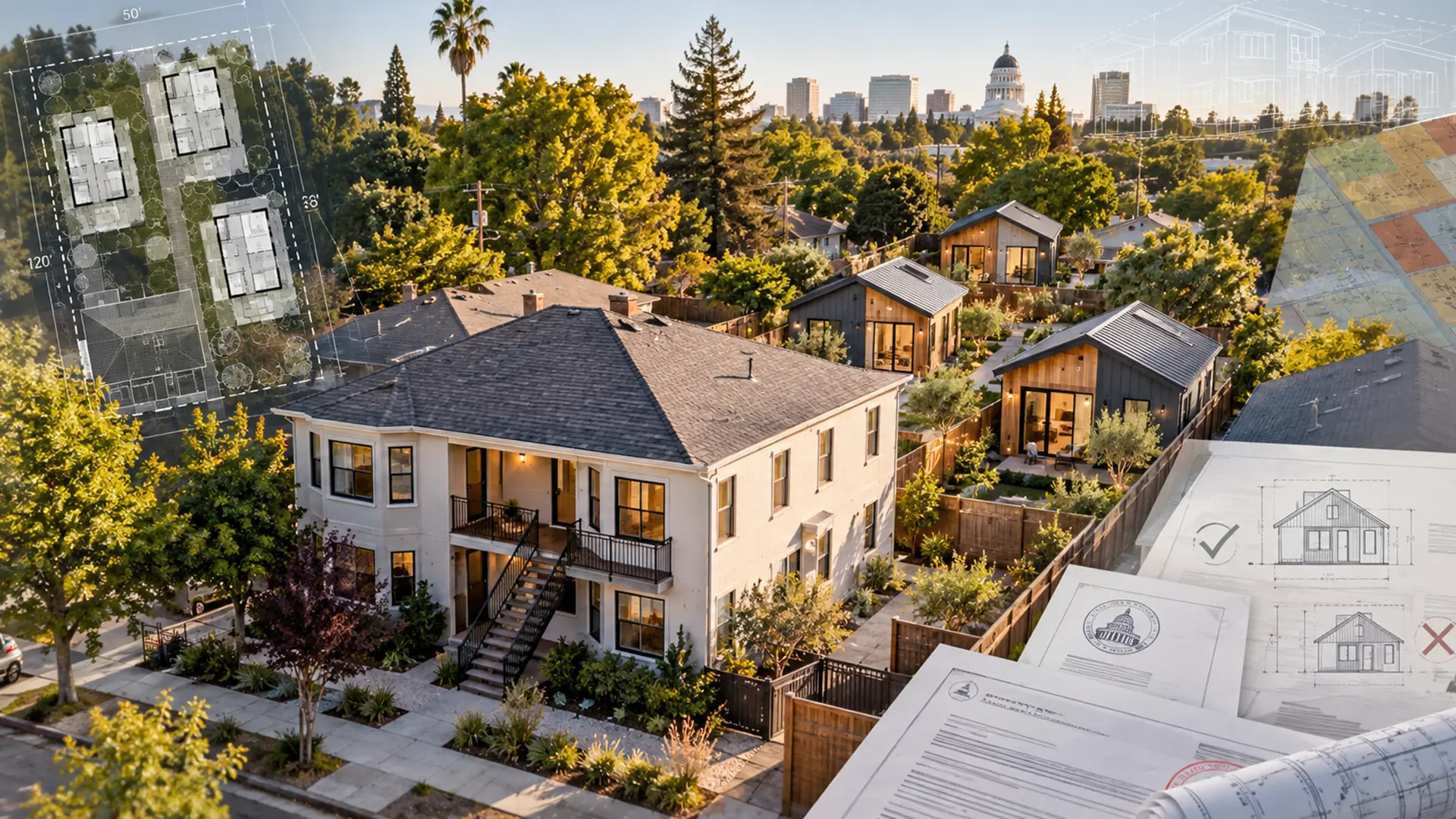
Say you own a small apartment building in the City of Sacramento and you want to add backyard units. You look up the city's accessory dwelling unit (ADU) rules, and the code says a lot with an existing multifamily building can have two detached ADUs.
State law says something different. Since January 1, 2025, California has allowed up to eight detached ADUs on a lot with an existing multifamily building, as long as the number doesn't exceed the units already there. In January 2026, the California Department of Housing and Community Development (HCD) reviewed Sacramento's ADU ordinance and found it out of step with state law in six ways. The two-unit limit was one of them.
Sacramento isn't unusual. Across the Sacramento region and the Bay Area, several local ADU codes still show numbers that state law has already overridden. The code on your city's website is where most people start. It isn't always where the answer is. This article explains why that happens, where it has happened, and how to find out which rule actually applies to your lot.
California has changed its accessory dwelling unit (ADU) law almost every year since 2020, and local ordinances haven't kept up. Height limits changed in 2023. The law was reorganized into Government Code sections 66310 through 66342 on January 1, 2025, and the multifamily allowance went from two detached units to as many as eight that same day. More changes took effect in 2025 and 2026, including how ADU size is measured.
Each change is supposed to flow into every city and county ordinance. In practice, a city has to draft an update, adopt it, and send it to the state. That takes time, and some cities are several changes behind.
The state has a way of catching this. HCD reviews local ADU ordinances and can issue written findings when one conflicts with state law. According to HCD, under 2025 legislation, a city that doesn't submit its ordinance or respond to findings on time can have its local ordinance treated as null and void. When that happens, state law becomes the rule the city has to apply.
State law wins wherever a local rule would give you less than the state guarantees. A city can be more generous than the state. It can't be stricter than the minimums the state sets.
The minimums that matter most for size and height are these. A city can't set its ADU size limit below 850 square feet for a studio or one-bedroom, or below 1,000 square feet for more than one bedroom. Every city has to allow a detached ADU of up to 800 square feet with 4-foot side and rear setbacks, even where its lot coverage, floor-area ratio, open-space, or front-setback rules would otherwise block it.
Height is set in tiers:
State law has no one-story limit. A two-story ADU is possible if it fits the applicable height and meets the building code.
An out-of-date local code isn't always a stricter one. State ADU rules are minimums, and several cities allow more through their own local programs. What you want is the more generous standard for your particular project, and you have to ask the city which one it's applying.
A few examples from the Sacramento and Bay Area codes:
The catch is that a generous local program and an out-of-date one can be the same program. In Sacramento, HCD's January 2026 findings objected to the city treating its local pathway and the state pathway as separate options you have to choose between. HCD's position is that you're entitled to combine them.
This section covers seven jurisdictions where state findings or out-of-date guidance affect accessory dwelling unit (ADU) rules. It reflects public records as of September 2026. A city or county can adopt a correction at any time, so confirm the current status before relying on any of it. It isn't legal advice.
The City of Sacramento's ADU rules are in City Code section 17.228.105, adopted through Ordinance 2024-0051 in December 2024. On January 20, 2026, the California Department of Housing and Community Development (HCD) found the ordinance noncompliant in six respects. The findings included the two-detached-unit limit for multifamily lots, street-side and front-setback rules applied to state-protected units, and separating the local and state pathways. We couldn't confirm that the city has adopted a corrected ordinance. If you're planning an ADU in the City of Sacramento, expect the state's multifamily count and setback rules to control where the city's text conflicts.
Unincorporated Sacramento County regulates ADUs under Zoning Code section 3.2.5. County guidance has allowed a detached ADU of up to 1,200 square feet and limits attached ADUs to 50 percent of the main house, subject to the state minimums. We couldn't confirm that the county has adopted an update matching every 2025 and 2026 change, so state law controls where they differ. Floodplain, levee, airport, and agricultural designations can still affect where an ADU fits on a county parcel.
In October 2023, HCD found San Francisco's ADU rules out of step with state law in several ways. HCD rejected the city's repeated 16-foot height limit, because the state's taller tiers apply where they qualify. HCD also required that the city's rear-yard rule and front setbacks give way where they would block the protected 800-square-foot unit. San Francisco has since adopted Ordinance 222-25 as its latest update to the state-mandated program. It's worth confirming that the city's published code reflects it before you design around a specific number. Parcels near the western shoreline can also fall under coastal zone review.
San José's published ADU checklist ties the detached ADU size limit to lot size. It shows 1,000 square feet on lots under 9,000 square feet and 1,200 square feet on larger lots. It also shows 18 feet for a one-story detached ADU, 24 feet for a two-story, and a two-unit limit for multifamily lots. In December 2025, HCD sent the city a technical-assistance letter noting that the latest ADU ordinance it had on file was from 2021 and may no longer comply with state law. For a project in San José, treat the checklist as a starting point. Ask the city which ordinance is in effect before you size the unit. The two-unit multifamily limit has already been replaced by the state's allowance of up to eight.
Oakland adopted its current ADU ordinance on July 15, 2025, and HCD found it noncompliant on December 10, 2025. One issue was Oakland's S-9 fire safety zone, which restricts new construction. HCD's position is that ADUs in the state-mandated categories must be exempt from those restrictions. HCD also found some of the city's visibility standards too subjective and its front-setback prerequisites unlawful. Oakland's size limits themselves track the state: 850 square feet for a studio or one-bedroom and 1,000 square feet for two or more bedrooms.
Unincorporated Alameda County has two documents that disagree. The county's June 2024 handout allows 850 square feet for one bedroom or less and 1,200 square feet for more than one, for both attached and detached ADUs. A draft ordinance presented in January 2026 proposed 850 and 1,000 square feet for attached ADUs instead. We couldn't confirm that the draft has been adopted. The 2024 handout also still refers to two detached units on multifamily lots, which state law has replaced.
HCD issued findings on unincorporated Santa Clara County's ADU rules in April 2025. The county's materials use 850 square feet for up to one bedroom and up to 1,200 square feet for two or more bedrooms on detached ADUs. We couldn't confirm when, or whether, the county adopted a corrected ordinance. Rural, hillside, and scenic-road districts add their own standards, but they can't reduce what state law guarantees.
Local accessory dwelling unit (ADU) codes tend to fall out of step with state law in the same five places. If your city isn't listed above, check its code for these first.
Ask the city in writing which standard it will apply, after checking two things yourself. Doing this first keeps you from designing around a number that won't hold.
What you do next depends on what you find:
If the ordinance is current and HCD hasn't flagged it, the local code is a reasonable guide. Design to it, and still confirm any number your project depends on.
If HCD has issued findings the city hasn't resolved, assume the state standard controls on the points HCD raised. The written determination matters most here, because you want the city's position on record before plans are drawn.
If the ordinance predates the 2025 changes and nothing newer has been adopted, expect the state rules to govern wherever the two differ. Ask the city directly which state standards it's using in place of its code.
This settles which rules apply. It doesn't settle what your lot can physically hold. Septic capacity, electrical service, fire access, and what's already in your backyard can shrink a legally allowed ADU, and whether your property can actually support an ADU is a separate question worth answering early.
It may not. If you're planning a single-story detached accessory dwelling unit (ADU) of 800 square feet or less, with at least 4 feet from the side and rear property lines, state law already protects that unit against most of the local rules that tend to be out of date. For that project, the gap between your city's code and state law probably won't come up.
It matters when your project depends on the edges of the rules: a second story, a height above 16 feet, more than two units on a multifamily lot, a reduced setback, or a lot inside an overlay zone. Those are the places where a stale local number and the state's number diverge.
When they do, the question gets settled at plan check, between whoever drew the plans and the city. We draw the plans and process the permit, so that conversation with the planning counter is ours to have, not yours. You can see what that covers on our ADU design and construction page. If you know what you want to build, send us the address and the project. We'll start by finding out which standard the city will apply to that lot.
From residential remodeling to commercial construction