9.25.2026
Why "Move-In Ready" Retail Space Still Produces Change Orders
This is the default text value
This is the default text value
This is the default text value
,
This is the default text value
This is the default text value
Lorem ipsum dolor sit amet, consectetur adipiscing elit. Suspendisse varius enim in eros elementum tristique. Duis cursus, mi quis viverra ornare, eros dolor interdum nulla, ut commodo diam libero vitae erat.
Default Button Text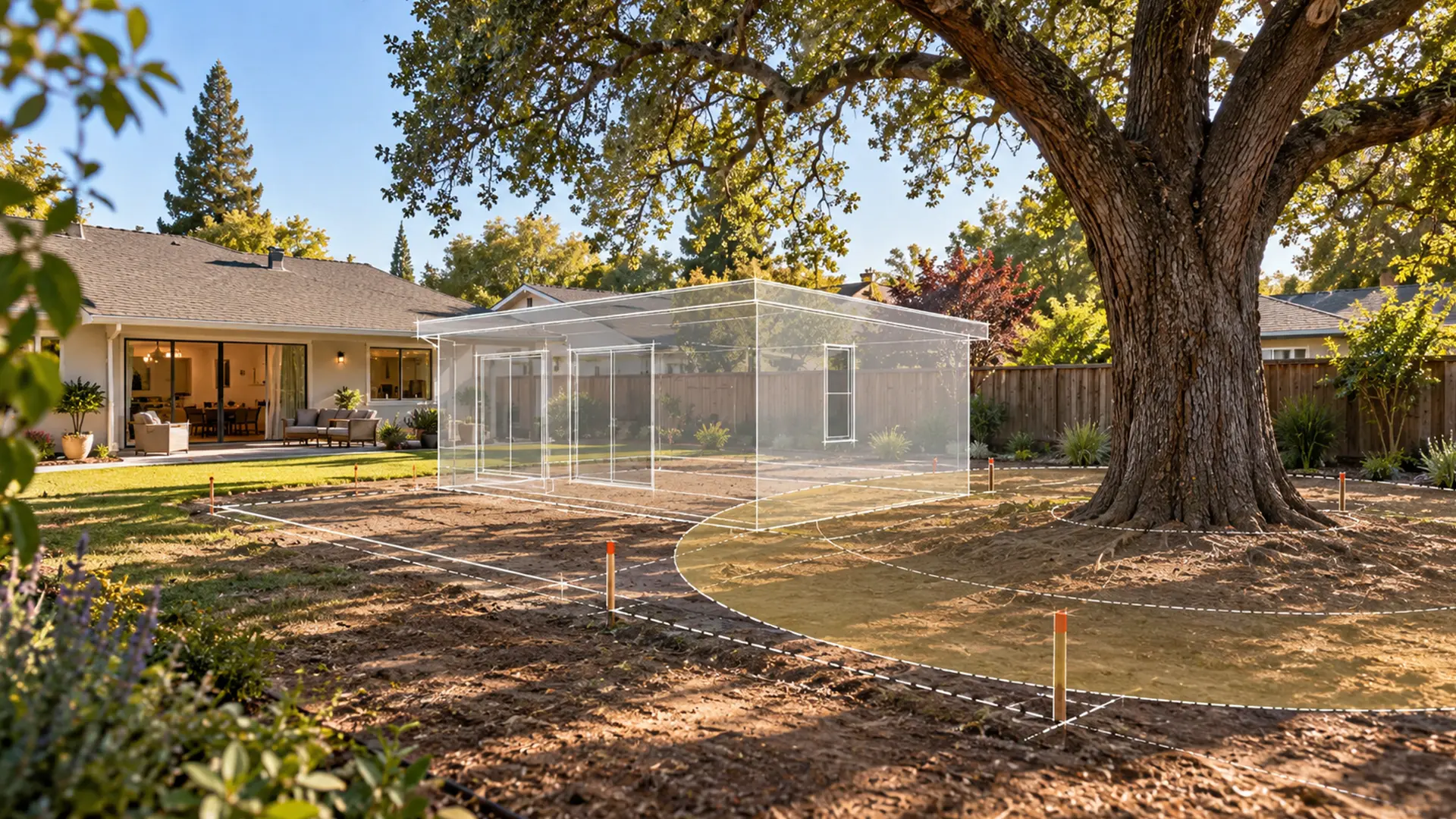
It's an easy sequence to fall into. You sketch an 800-square-foot backyard accessory dwelling unit (ADU). It clears the 4-foot side and rear setbacks. Then an arborist walks the yard, measures the oak by the back fence, and draws a circle on your site plan. The circle runs through the kitchen.
At that point the tree hasn't cost you anything. The drawing has. Now you're paying to redesign, and the decision about the tree is being made under pressure instead of on purpose.
Whether you keep the tree, remove it, or design around it, that decision gets cheaper the earlier you make it. On a lot with a mature tree, the order matters: survey first, then the arborist, then which state approval path you're on, and only then the footprint. This guide walks through that order. It uses Sacramento's rules as the worked example, because the city and the county publish theirs clearly.
Setbacks tell you where a building is allowed to stand. A tree controls a much bigger area: the soil its roots live in, the space under its canopy, and every path an excavator or trench takes to reach your build site.
Three terms come up constantly. The drip line is the outer edge of the canopy, traced on the ground. It's easy to measure, but roots don't stop there. The critical root zone is the soil the tree depends on for water and stability. The tree protection zone is the area your city or your arborist fences off from digging, fill, paving, and equipment during construction.
Sacramento County's standard for arborist reports on projects reviewed by its planning department draws the root protection zone as a circle. The radius runs from the trunk to the tip of the longest limb. The arborist can make it larger when the tree needs more room.
The building isn't the only thing that has to stay out of that circle. The City of Sacramento treats grading, trenching, boring, compacting, paving, and storing construction equipment inside a protected tree's protection zone as regulated work that needs a permit. So an ADU that misses the tree entirely can still trigger review because its sewer line crosses the root zone. Trees sit alongside septic, power, and fire access on the list of things that decide what your lot can actually support.
That depends first on whether you're inside a city or in unincorporated county land, because each writes its own rules. After that, it depends on the tree's species and trunk size.
The City of Sacramento protects any private tree with a trunk diameter of 32 inches or more on a lot with a single-unit or duplex home. Certain native species are protected at smaller sizes, and the City Council can designate individual trees. You need a permit to remove or prune a protected tree, or to do regulated work near it. If a removal is approved on a single-unit or duplex lot, the city requires one replacement tree for each protected tree removed.
Sacramento County regulates native oaks, certain other native species, and public trees. A California native oak with a trunk at least 60 inches around, measured 4.5 feet above the ground, is a heritage tree. That's roughly 19 inches in diameter. The county's tree permit form, revised April 2026, lists a typical review time of 10 working days or less and a $31.95 permit fee. The county notes that fees change, so check the current amount before you apply.
Don't assume a dead or declining tree is exempt. Ask the county before anyone cuts.
Every Bay Area city writes its own tree ordinance. Size thresholds, protected species, neighbor notice, and replacement rules all vary. The sequence in this guide is the same everywhere, but the numbers aren't. Pull your own city's current tree code before you rely on anything here.
Get the survey first, the arborist second, and the design third. If the footprint gets drawn before the tree is mapped, you'll pay to draw it twice.
The survey ties every trunk to your legal property line, along with easements, utilities, and grade. Your fence is not your property line. When a tree sits close to the boundary, only a survey settles whose tree it is.
The arborist works from that survey. Hire an arborist certified by the International Society of Arboriculture (ISA). Sacramento County's standard for reports submitted to its planning department is a useful model of what a thorough report covers:
Ask the arborist one more thing: which construction methods would be acceptable inside the protection zone, and where. That answer shapes the foundation and utility routing later.
An arborist isn't a structural engineer or a surveyor, and doesn't decide whether a removal gets approved. The report is evidence. The city or county makes the call.
We draw the plans and process the permit. That's why we want the tree map in hand before the first sketch, not after it.
It can. California has two approval routes for an accessory dwelling unit (ADU), and they don't give your city the same room to add requirements. Decide which route you're on before you ask to remove anything.
Under section 66314, your city reviews the ADU under its own ADU ordinance. The statute lets the city apply objective standards, and it names landscaping among them. This route can allow a larger unit. In exchange, the city's written tree and landscape standards are more likely to apply.
Section 66323 lists categories of ADUs the city must approve. One is a detached, newly built ADU on a single-family lot. For that unit, the city can limit floor area to 800 square feet, set 4-foot side and rear setbacks, and apply the state height limits. It can only impose the conditions the statute lists. The state housing department, the Department of Housing and Community Development (HCD), takes the position that these units need only a building permit and aren't subject to a city's ordinary objective standards. In 2024, Oakland's ADU code update dropped a requirement to plant trees as a condition of ADU approval.
Whether a city's separate tree ordinance can still block a tree removal for a section 66323 unit hasn't been decided by a published California appeals court decision that we're aware of. A city could argue it isn't denying your ADU, just the tree removal. If a protected tree sits on the only spot for a qualifying unit, ask the planning department how it applies its tree rules to each route, and get the answer in writing.
The practical version: if 800 square feet works for you, the section 66323 route may take some local requirements off the table. If you need a bigger unit, expect the city's tree standards to come with it. For more on how state ADU law overrides older local code, see why Sacramento's code and state law disagree on backyard ADUs.
Start by moving or reshaping the building, because that usually disturbs the least. Then look at converting an existing structure. Then look at foundations that span roots instead of digging through them.
An L-shape, a narrower plan, or a slightly smaller unit can leave the trunk and the densest roots outside the work area. If another code-compliant spot exists on the lot, relocating is often the simplest answer. It can make access, privacy, or utility runs worse, so weigh those too.
A garage or other existing structure sits on ground that has already been disturbed. Converting it avoids most new excavation, although new plumbing and electrical lines can still cross roots. A garage conversion is worth pricing alongside new construction whenever a tree is in play.
Several foundation types reduce digging near roots. Each one has limits.
No foundation is tree-safe by itself. The arborist marks where digging is acceptable. The structural engineer designs to that map. The crew has to follow it in the field. The city still inspects it, and our guide to what the foundation inspection checks covers that step.
Sewer, water, and electrical lines are where many tree plans fail. A building can avoid the tree while its trench cuts straight through the roots. Routing around the protection zone is the most reliable option. Boring under it or digging by hand are alternatives when going around isn't possible.
Fencing goes up before demolition starts, and it stays up. Nothing gets stored or parked inside the protection zone. The arborist should be on site at set points, such as the first time roots are exposed and before any root is cut.
Construction damage can take years to show. Plan on an arborist looking at the tree once a year for several years after you move in.
No. Keeping the tree is often cheaper when a modest change to the design avoids the conflict, or when removal may not be approved at all.
Removal brings the permit, the removal and stump work, and any replacement planting the city requires. You also lose the tree's shade, and that loss is measurable. In a USDA Forest Service computer simulation, a single 24-foot tree on the west side of an energy-efficient Sacramento house cut annual cooling energy by about 12 percent. That's a modeled house, not your house, but west-side shade is the most valuable shade you have.
Keeping the tree can bring a specialty foundation, longer utility runs, hand digging, arborist visits during construction, and redesign time.
We're not going to give you a cost range for either side. We couldn't find current, disinterested local data for arborist work, tree removal, or specialty foundations, and a range nobody can back up is worse than no range. Instead, ask for the alternatives priced side by side: a conventional foundation outside the protection zone, a tree-sensitive foundation, and removal with any required replacement. Sometimes the cheapest answer is moving the unit. That's worth knowing before you commit to either the expensive foundation or the removal fight.
Roots crossing onto your side don't give you an unlimited right to cut them. California courts require you to act reasonably toward the tree's owner.
In Booska v. Patel (1994), a California appeals court looked at a homeowner who severed a neighbor's tree roots on his own side of the line. The court held that the right to cut encroaching roots is limited by a duty to act reasonably. If your foundation trench kills or destabilizes the tree next door, you can be liable for the harm.
The stakes go up if anyone goes onto the neighbor's land. California Civil Code section 3346 and Code of Civil Procedure section 733 allow doubled or tripled damages for wrongfully injuring or removing someone else's tree. Courts have generally applied them where there was an actual trespass, and how they apply depends on the facts.
Ownership follows the trunk. A tree whose trunk stands entirely on the neighbor's side belongs to the neighbor, even when its roots and branches reach your yard. A trunk that straddles the line is owned in common. Only a survey settles which case you have.
Some jurisdictions require the owner's sign-off. Sacramento County won't process a permit for work on a tree on neighboring property without a signed, dated letter from that property's owner.
In practice, show your neighbor the arborist report before the design is final. Then get a written agreement covering access, root investigation, and any pruning.
This is general information, not legal advice. If your project could affect a neighbor's tree, or ownership is unclear, talk to a California real estate attorney before anyone digs.
Five things settle most of the tree question before anyone draws a floor plan:
This approach suits homeowners who'd rather get the hard answer early. Sometimes the answer is "move the unit," "convert the garage instead," or "this tree has to stay." That isn't a setback. It's the decision arriving while it's still cheap to change course.
We draw the plans, process the permits, and build, so the tree map shapes the first design instead of the second one. If you want to see what that covers, our ADU design and construction page walks through the scope. Bring the five items above, and the conversation starts from your lot instead of from a guess.
From residential remodeling to commercial construction