10.23.2026
Where Will Your ADU’s Shadow Land? Panels, Yards, Neighbors
This is the default text value
This is the default text value
This is the default text value
,
This is the default text value
This is the default text value
Lorem ipsum dolor sit amet, consectetur adipiscing elit. Suspendisse varius enim in eros elementum tristique. Duis cursus, mi quis viverra ornare, eros dolor interdum nulla, ut commodo diam libero vitae erat.
Default Button Text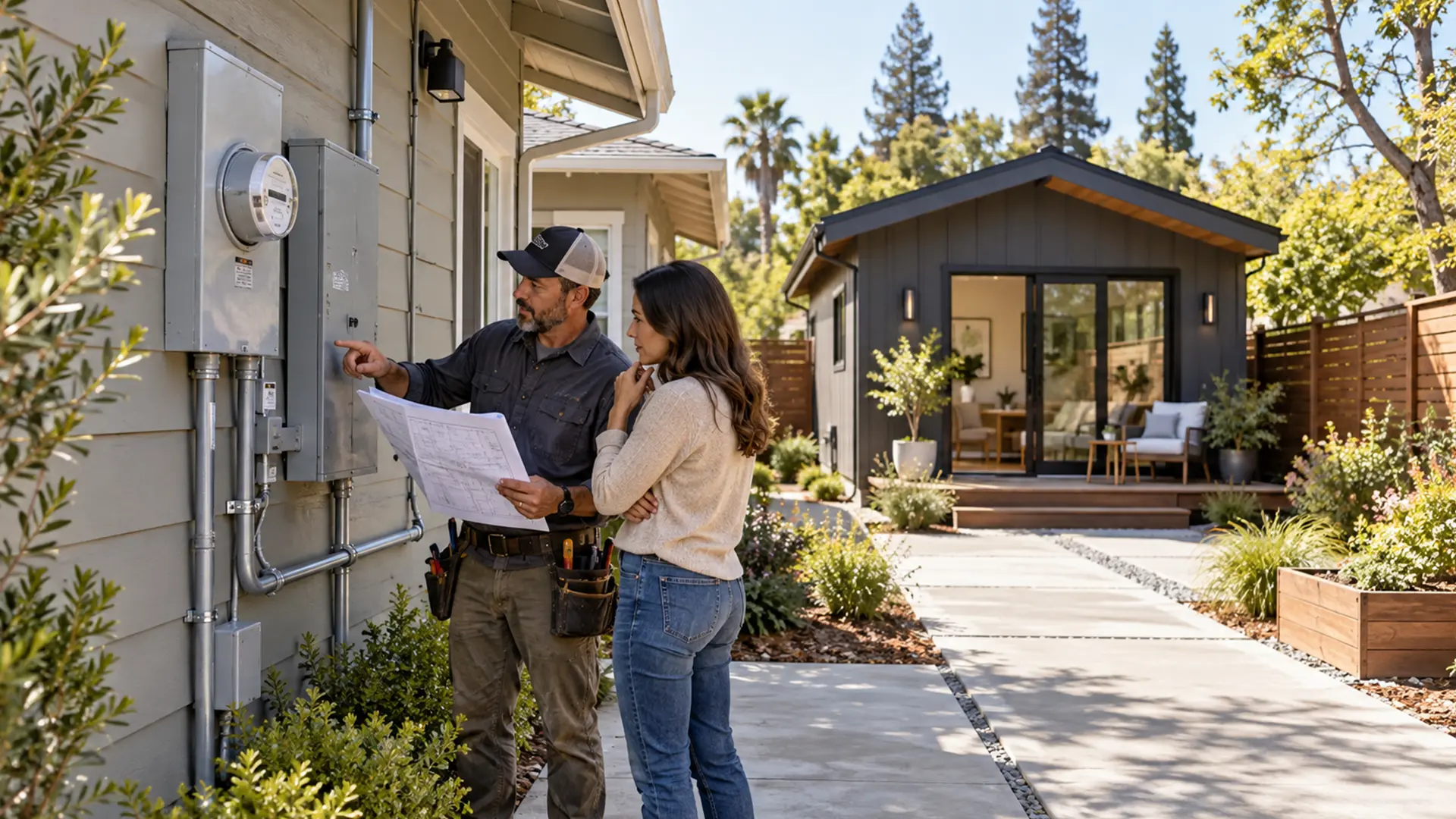
You ask whether your new accessory dwelling unit (ADU) needs its own electric meter, and you get three answers. The city says it doesn't require one. The electrician says the house panel can feed the unit through a subpanel. Then the utility says the unit needs its own meter, with its own address, before it will set anything.
All three can be right at the same time. Each one is answering a different question, under a different set of rules. The city answers for state ADU law and its own permit. The electrician answers for the electrical code. The utility answers for its tariff, and on the meter question, the utility usually has the last word.
This guide covers how that decision gets made in Sacramento and the Bay Area: which utility owns your meter, what each one says about ADUs, how a garage conversion or a junior ADU changes the answer, and what to get in writing before your site plan is drawn. It won't give you a cost or a timeline, because both depend on your utility's review of your specific project.
There's no single California rule that says yes or no. Whether an accessory dwelling unit (ADU) gets its own meter depends on three things: which utility serves your home, what kind of ADU you're building, and what that utility decides when it reviews your project.
It helps to separate four things that often get treated as one:
A detached ADU can have its own subpanel and still sit behind one meter. A property can have two meters with both accounts in the homeowner's name. And a city can give an ADU its own unit number even though no utility requires a second meter. Keeping these apart is most of what makes the rest of this make sense.
Because the California Electrical Code and your utility's tariff are separate rulebooks, and the tariff can be stricter. The code sets the minimum for safe wiring. The utility sets the terms on which it will deliver and measure power.
Under the 2025 California Electrical Code, which took effect January 1, 2026, a detached building can be supplied by a feeder from the main house's electrical service. Article 225 covers feeding a separate building that way, and Article 250 covers the grounding at the second building. So as a wiring matter, a backyard ADU can run off your house panel through a properly sized feeder to its own subpanel.
That's why "the code says one service is fine" and "the utility wants a second meter" don't contradict each other. A building inspector can approve the feeder design while the utility still requires the ADU to be metered on its own. The feeder, the subpanel, and the grounding all get checked before the walls close, which our guide to the rough plumbing, electrical, and mechanical inspection walks through.
If Pacific Gas and Electric (PG&E) delivers your electricity, plan on an ordinary ADU getting its own meter. PG&E's Electric Rule 18 says separate premises generally aren't supplied through one meter, and that PG&E meters individual residential dwelling units.
Rule 18 has one written exception that matters here. A junior accessory dwelling unit (JADU) is not required to be separately metered. Rule 18 also says a JADU doesn't need a separate address for PG&E electric service. A JADU is a unit of up to 500 square feet built entirely inside your existing single-family home.
City guidance in PG&E territory lines up with this. The City of San José says it doesn't itself require a separate ADU meter, but warns that PG&E may require one. Another San José ADU page says PG&E is now requiring ADUs to have their own meter. The city isn't wrong, and neither is PG&E. They control different decisions.
Two points that trip people up:
PG&E makes the final call for each project, so treat "plan on a separate meter" as a design starting point, not a guarantee in either direction.
Then the answer comes from that utility's review of your project, not from PG&E's rules. Neither the Sacramento Municipal Utility District (SMUD) nor Roseville Electric publishes a blanket rule that every ADU must have its own meter, or that every ADU can share one.
Roseville Electric's panel-upgrade application asks directly whether a new meter is being added for an accessory dwelling unit (ADU). If you answer yes, the form says a utility representative will contact you to discuss your options. The form also asks you to contact Roseville Electric before applying for the building permit, and it warns that an upsized panel can require customer-owned conduit and wire upgrades. If you're planning an ADU in Roseville, that early conversation is where the meter question gets answered.
SMUD runs new meters through its design and construction services, and its materials point ADU applicants to its planning information. The published sequence is: meet your local agency's requirements, submit the SMUD application, pass the local electrical inspection, and then SMUD sets the meter and energizes the service. What SMUD's public material doesn't do is state a single ADU rule, so get its answer for your project in writing.
Not every Bay Area home is on PG&E for electricity. Palo Alto, Santa Clara (Silicon Valley Power), Alameda (Alameda Municipal Power), and Healdsburg run their own electric utilities. None of them publishes an ADU-by-ADU meter rule either. If you're in one of those cities, don't borrow PG&E's answer. Ask your own utility.
One Sacramento-area detail catches people: a home can get electricity from SMUD and gas from PG&E. That means two utilities, two sets of rules, and two separate applications if the ADU uses gas.
It can, but less than many guides suggest. California ADU law protects ADUs created from existing space, like a garage conversion, from being required to install a new or separate utility connection. That protection applies to a local agency, a special district, or a water corporation. It doesn't bind PG&E.
The state housing department, the Department of Housing and Community Development (HCD), describes this rule in its March 2026 ADU Handbook. It covers units created under Government Code section 66323(a)(1). HCD also states that it has no regulatory authority over electric or gas utilities, and it directs disputes with a private utility like PG&E to the California Public Utilities Commission (CPUC).
So the protection works differently depending on who serves you:
If you're weighing a conversion against a new backyard unit, our comparison of converting an attached garage versus building a detached ADU covers the other costs that decide it. One note on older material: ADU statutes were renumbered in 2024 and again for 2026, so a guide citing Government Code section 65852.2 is pointing at a statute that moved.
Not necessarily. Whether your property needs a bigger electrical service depends on the total load your house and your ADU will draw, not on how many meters measure it.
If the ADU shares your meter, one service has to carry both homes. That can mean a larger main panel, larger service wires, or utility work on the transformer. If the ADU gets its own meter, it can still need utility-side work, because both meters may draw from the same transformer.
The things that drive the size of the electrical job are:
Our guide to whether your property can actually support an ADU covers how to read your panel rating and what else your lot decides before design starts.
If the accessory dwelling unit (ADU) will use gas, PG&E's gas rules and its separate second-gas-meter process apply. If the ADU is all-electric, the gas question goes away, but its heating, hot water, and cooking load moves onto your electric service.
PG&E's Gas Rule 18 applies the same individual-unit metering approach as its electric rule. For an additional ADU gas meter, PG&E asks you to list the existing and new gas appliances and their loads, so it can confirm the meter and service can carry the total.
There's a real gap for junior accessory dwelling units (JADUs). PG&E's electric rule says a JADU doesn't need its own meter. Its gas rule doesn't say anything comparable. That silence doesn't mean a JADU always needs a second gas meter, and it doesn't mean it never does. If your JADU will use gas, ask PG&E for a written answer.
Going all-electric removes the gas meter, the gas line extension, and the gas account from the project. It doesn't resolve the electric meter question. And it makes the electrical load calculation matter more, because the water heater, the heating, the range, and possibly the dryer are all now on the electric service.
Statewide, yes. The 2025 California Energy Code, in effect for 2026, doesn't ban gas in new single-family construction. When gas appliances are installed in a new home, it requires the building to be electric-ready for a future switch, for space heating, water heating, cooking, and clothes drying.
Local rules are where people get misled. Many Bay Area cities adopted all-electric ordinances in earlier code cycles, and online maps still show them. Those maps don't reliably reflect the 2026 rules. Healdsburg, for example, says it is no longer enforcing its former electrification reach code after the final Ninth Circuit ruling in the Berkeley case. Ask your building department what applies to your ADU under the current code cycle.
Because the utility sets a meter at an address, and that address has to match your permit. For an additional ADU gas meter, PG&E requires the exact ADU address. PG&E says that address must appear on the permit and inspection documents, not just the main house address.
Your city or county assigns the ADU's address, and practices vary. San José gives every ADU and junior ADU an address through the building permit process. The ADU gets a unit number, both numbers must be visible from the street, and the unit number has to appear at the ADU's entrance. For the Sacramento area, we didn't find published official guidance on whether an ADU gets a unit number or a new street number, so ask your planning counter.
The order that avoids rework looks like this:
A mismatch between the permit and the utility application is one of the more avoidable reasons a meter set stalls.
You can include utilities in the rent. Separately billing a tenant for metered use behind your own meter is a different matter, and a private submeter doesn't give you the right to do it.
A few points to know before you rent the ADU:
For a single house with one ADU, building utilities into the rent is generally simpler than inventing a billing scheme. This is general information, not legal advice. Talk to a California landlord-tenant attorney before charging a tenant separately for utilities.
No. Two meters and two addresses don't make an ADU a separate property you can sell. Separate sale is its own legal process, and only cities that have adopted it can offer it. San José's program, for example, runs through a condominium conversion with parcel maps and condominium documents. The ADU only gets a new, separately sellable address at the end.
Five answers settle most of the meter question for your ADU, and each is cheaper to get before the site plan is drawn than after:
The meter decision sets where the meter goes, how big the panel is, and where the trench runs. Those are easy to move on a drawing and expensive to move after they're built. We draw the plans and process the permit, so the meter location, the panel, and the trench all land in the same drawing set. Our ADU design and construction page covers what that work includes.
This works best when you already know how the unit will be used, whether that's a rental, a family unit, or a space for you. That answer shapes whether a second meter is something you want, not just something the utility requires.
From residential remodeling to commercial construction