10.23.2026
Will the Existing HVAC Actually Run Your Restaurant?
This is the default text value
This is the default text value
This is the default text value
,
This is the default text value
This is the default text value
Lorem ipsum dolor sit amet, consectetur adipiscing elit. Suspendisse varius enim in eros elementum tristique. Duis cursus, mi quis viverra ornare, eros dolor interdum nulla, ut commodo diam libero vitae erat.
Default Button Text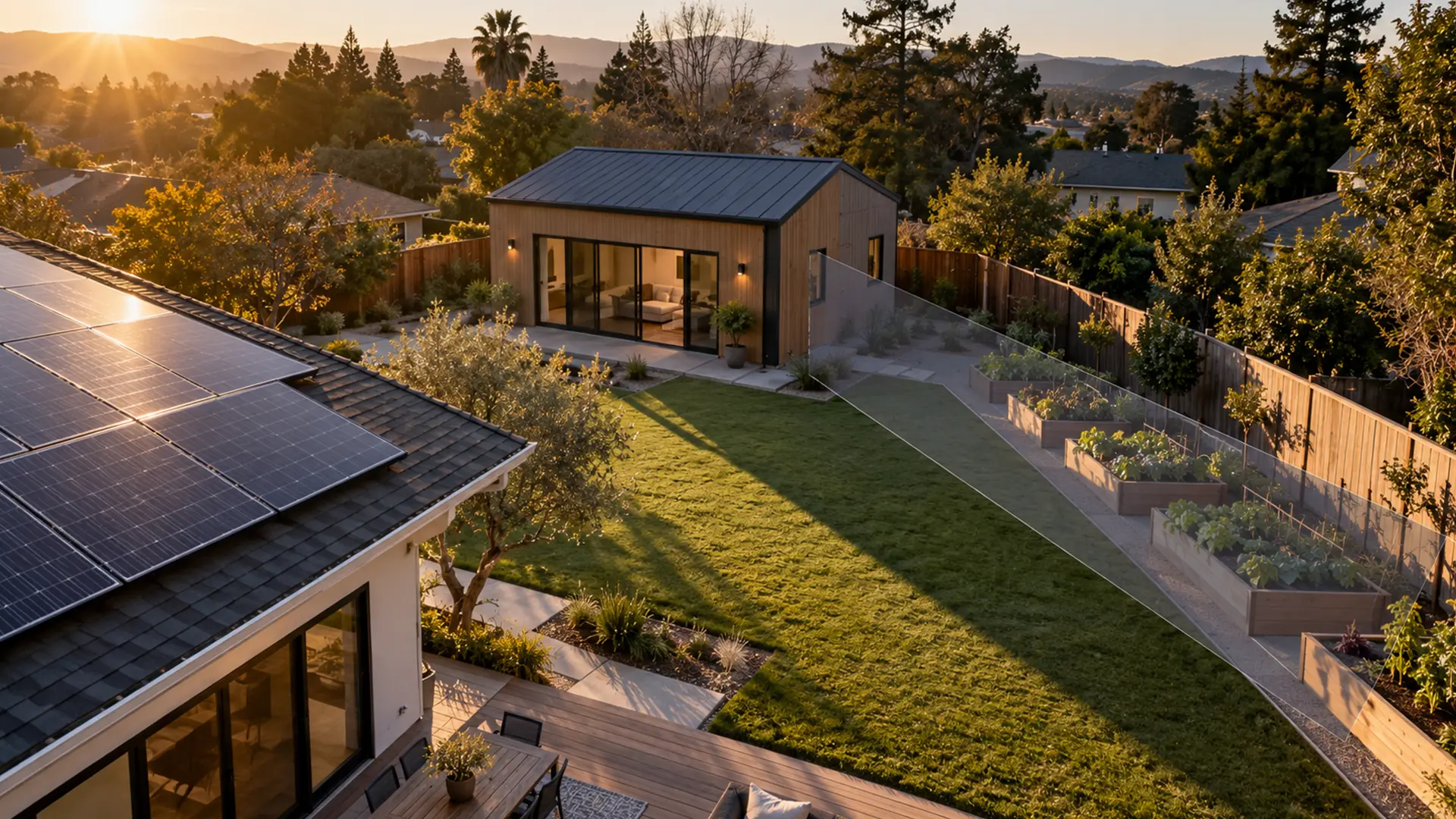
In July, the raised beds along your back fence get sun from mid-morning until evening. You build a new backyard accessory dwelling unit (ADU) just south of them, 16 feet tall at the ridge. The beds do fine all summer.
Then December comes. At noon, the ADU's shadow reaches about 29 feet across the yard, and the beds sit inside it. The winter greens you planted in October stop growing.
Nothing about that ADU broke a rule. It met the height limit and the 4-foot setbacks. Those rules decide where a building can stand. They don't say anything about where its shadow lands. That part gets decided by height, direction, and season, and most of it is settled once the site plan is drawn. This guide covers what your ADU's shadow will reach, what it costs you, what it costs your neighbor, and what you can change before the drawings go in. It applies to Sacramento and the Bay Area.
Around Sacramento and the Bay Area, a roof point 16 feet above level ground casts a shadow about 29 feet long at noon on the winter solstice. In summer at noon, the same point casts a shadow only about 4 feet long.
These figures come from standard sun-angle geometry at about 38 degrees north latitude, which sits between San Francisco and Sacramento. They're calculated, not measured on any real site. They assume level ground, and "noon" here means solar noon, when the sun is highest, which can differ from clock noon by an hour or more.
The quickest way to use them is as a multiplier on height:
Slope changes the numbers. On ground rising 10 percent away from the ADU, that 29-foot winter-noon shadow shortens to about 25 feet. On ground falling 10 percent, it stretches to about 36 feet. A taller roof point stretches every figure in proportion. A 25-foot point casts about 46 feet at winter noon.
A long shadow isn't the same as a long period of shade. The shadow swings across the yard as the sun moves, and a narrow building blocks the sun for less time than a wide one at the same height. These lengths tell you how far the shadow can reach. It doesn't tell you how long anything sits in it.
A setback controls distance, and a shadow is controlled by height and sun angle. A 16-foot roof point standing 4 feet from the property line can put a winter-noon shadow about 25 feet into the neighbor's yard, on level ground.
A 25-foot point at the same 4 feet can reach about 42 feet past the line. Neither figure means the neighbor's yard will actually be shaded. Their pool or garden may sit off to one side of the shadow, or higher than your lot. The point is that meeting the setback and keeping the sun off the next yard are different questions, and the setback only answers the first.
California's ADU rules allow 4-foot side and rear setbacks and set height limits that start at 16 feet for most detached units. Our guide on what your property can actually support covers those limits and the site conditions that shape a footprint.
Usually less than you'd expect from a single-story ADU, because what matters is the ADU's height above the panels, not above the ground. A 16-foot ADU next to roof panels sitting 12 feet up is only a 4-foot obstruction to those panels.
That 4-foot difference casts a winter-noon shadow of about 7 feet and an equinox-noon shadow of about 3 feet. A two-story or above-garage ADU is a different calculation. A 25-foot ridge next to the same panels is a 13-foot obstruction, with a winter-noon shadow of about 24 feet. Our piece on window privacy on two-story ADUs covers the other neighbor question a second floor raises.
A solar photovoltaic (PV) system doesn't lose power in proportion to the shaded area. When panels are wired together in a string, one shaded panel can drag down the output of the panels around it. In one National Renewable Energy Laboratory (NREL) test of a single string, the power loss was more than 30 times what the shaded area alone would suggest. That was one specific test setup, not a rule for home systems.
Microinverters and power optimizers limit how much one shaded panel affects the others. They don't put back the sunlight the ADU blocks. If your system has them, that helps. It isn't a reason to skip checking. If you're adding or rearranging panels as part of the project, our solar installation page covers that work.
It depends on who your utility is, and on whether the power you lose would have run your house or gone back to the grid. Power you would have used yourself is worth whatever you pay per kilowatt-hour (kWh). Power you would have exported is worth your utility's export credit, which is usually much less.
That makes the timing of a shadow matter. A shadow that falls during hours when you'd be exporting costs you less than the same shadow during hours when you'd be using the power.
Most of the Bay Area and parts of the Sacramento region are served by PG&E. Customers whose solar interconnection applications were submitted on or after April 15, 2023 are on the Net Billing Tariff adopted by the California Public Utilities Commission (CPUC). Under it, exported power is credited based on its value to the grid, which changes by hour and season, rather than at the retail rate.
SMUD isn't regulated by the CPUC's net billing rules. Its Solar and Storage Rate credits exported power at 9.6 cents per kWh, effective June 1, 2026. That rate is the same at any hour and in any season. SMUD reviews it every four years, so this figure is set to hold until the 2030 update. The export credit can only offset electricity usage charges on your bill.
Roseville runs its own utility too. Systems interconnected on or after October 1, 2018 are on its Roseville Solar 2.0 program, which listed a surplus energy compensation rate of about 6.9 cents per kWh on the utility's current rate page. Systems interconnected before that date stay on the older net metering rate for up to 20 years from interconnection.
A few Bay Area cities, including Palo Alto and Santa Clara, also run their own utilities with their own solar rates. Whatever your utility, check your actual rate plan before putting a dollar figure on a shadow. A shadow study measured in kWh lost can't tell you your bill impact on its own.
If it's a newly built detached ADU, generally yes. Section 150.1(c)14 of the 2025 California Energy Code requires a solar photovoltaic (PV) system on newly constructed single-family buildings, and the California Energy Commission treats a new detached ADU as one, unless an exception applies.
The new panels don't have to sit on the ADU. The Energy Commission allows them to be added to an existing PV system on the same lot, if your utility allows the existing system to be expanded. An attached ADU counts as an addition rather than a new building, so this requirement doesn't apply to it. A conversion of an existing structure, such as a garage conversion, isn't a newly constructed building either.
This turns the shadow question into a placement question. The ADU you're adding is often the newest, least-shaded roof in the yard. It may also be the thing shading your existing panels. Where the ADU stands, which way its roof slopes, and where its required panels go are one decision. They're easiest to settle together, before the site plan is final.
It depends on what's growing and in which season. University of California (UC) Master Gardener guidance puts it roughly like this:
Winter beds are the most exposed, because winter shadows are the longest. UC guidance on cool-season gardening notes the lower sun and the added building shade that come with winter. A bed that still grows summer tomatoes after the ADU goes up can lose most of its winter usefulness. A bed you leave empty in winter loses very little.
Shade isn't always a loss. In hot inland summers, UC guidance recommends afternoon shade to protect some plants from heat stress, especially on west-facing exposures. A building isn't shade cloth, though. You can't take it down in March when seedlings need the sun.
A pool has several things that can lose sun: the water, the deck where people sit, and any solar collector that heats the water. An ADU can shade one without touching the others, so each needs its own check. A shadow map can show how many more hours of shade the water gets. It can't convert that into a water temperature or a heating bill, because wind, pool covers, depth, and the heater all affect the result.
Generally, no. California doesn't give property owners an automatic right to sunlight across a neighbor's land. A shadow from a new accessory dwelling unit (ADU) on their garden, pool, or solar panels doesn't, by itself, give a neighbor grounds to block it.
In Sher v. Leiderman (1986), a California appeals court declined to treat a neighbor's trees blocking sun to a solar-designed home as a nuisance. The court did recognize an exception for an obstruction put up out of malice. In Zipperer v. County of Santa Clara (2005), another appeals court rejected the argument that active solar panels should be treated differently. Neither case involved an ADU. We aren't aware of a published California appeals decision deciding a dispute over an ADU shading a neighbor's panels, pool, or garden.
The Solar Shade Control Act limits shade on a neighbor's solar collector from trees and shrubs planted after the collector went in. It doesn't cover buildings. It also exempts trees that were there first, and it lets any city or county opt out of the Act entirely. An existing array next door doesn't stop your ADU because the ADU would shade it. For the tree side of neighbor relations, our guide on planning an ADU around a tree covers who owns a boundary tree and what you can cut.
Check your title report for recorded easements and covenants before the design is final. A building permit doesn't settle private property rights, and it doesn't erase an easement on your deed.
This is general information, not legal advice. If a neighbor raises a recorded easement or covenant, talk to a California real estate attorney.
Sometimes. It depends on whether a written, measurable local standard applies to your ADU's approval path. State law limits how far a city can go. A general worry about shade isn't a standard a city can apply to an ADU that qualifies for ministerial, rules-based approval.
Bay Area cities show the range:
On the Sacramento side, we didn't find a published solar-access standard for ADUs in the City of Sacramento or Roseville code. That isn't proof none exists. Ask the planning counter directly, and get the answer in writing if a study is requested.
A general planning checklist that mentions shadow analysis isn't proof that your ADU needs one. Those checklists often cover larger projects on a different review path. Ask which code section requires the study and what measurable test it has to pass.
A shadow study is worth doing when the thing that matters is close, sits south or west of the ADU, and is low, like a garden bed or pool rather than a roof. It's also worth doing in these situations:
For a single-story ADU north of your garden and well away from any panels, a study usually tells you what the geometry above already does.
Shadows come from the building's real shape, not a box at its maximum height. A shed roof with its low edge toward the sensitive area keeps the tallest part farther away. A gable's ridge orientation changes how wide the highest part looks from the garden or array. Stepping an upper story back moves the mass out of the sunlight path. Sometimes the cheapest fix is sliding the whole ADU a few feet east or west.
A shadow map shows where and when shade falls. It doesn't estimate lost solar power. That takes the solar installer, working from the map and your actual panels and wiring, and then your utility's rates to turn it into dollars.
Before the site plan is final. A shed roof instead of a gable, a ridge turned 90 degrees, or a footprint moved 6 feet costs almost nothing on paper. After framing, the same change means a redesign and a new permit review.
This approach suits homeowners who want the placement, roof form, and panel layout settled before the drawings go to the city. Sometimes the answer is a lower roof than you pictured, or panels on the ADU instead of the house. That's easier to accept on a drawing than after the roof is on.
We draw the plans, process the permit, and build. So where the ADU sits, how its roof is shaped, and where its required panels go all land in one set of drawings. Our ADU design and construction page walks through what that covers.
From residential remodeling to commercial construction