11.13.2026
Architect, Engineer, or Designer? What Your Tenant Improvement Actually Triggers
This is the default text value
This is the default text value
This is the default text value
,
This is the default text value
This is the default text value
Lorem ipsum dolor sit amet, consectetur adipiscing elit. Suspendisse varius enim in eros elementum tristique. Duis cursus, mi quis viverra ornare, eros dolor interdum nulla, ut commodo diam libero vitae erat.
Default Button Text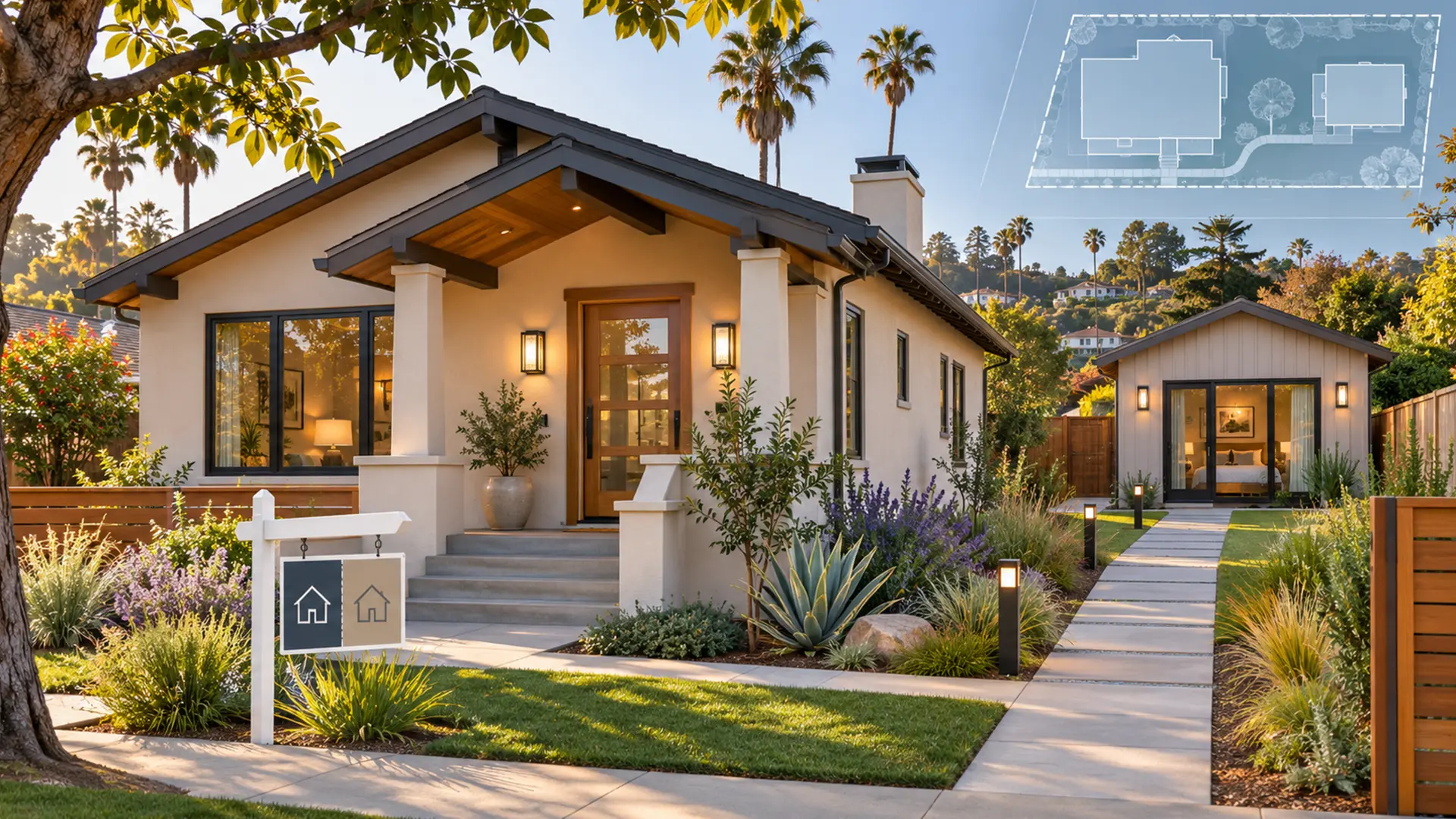
If you've talked to anyone about building an accessory dwelling unit (ADU), you've probably heard some version of "and you can always sell it separately later." In June 2026, an ADU in California was sold on its own for the first time. It was a 749-square-foot unit in San José. A developer built it, in the first city to set up rules allowing that kind of sale, and the rules had been in place for about two years before it closed.
So the honest answer to the question in the title is: maybe, depending on your city, and only if your ADU was built in a way that allows it. The first part is out of your hands. The second part is decided when your plans are drawn, often years before your city decides anything.
Only if your city or county has adopted its own ordinance allowing it. A state law called Assembly Bill (AB) 1033 took effect in January 2024. It lets cities and counties allow an ADU to be sold separately from the main house as a condominium. It doesn't require them to.
If your city hasn't adopted an ordinance under AB 1033, your city's default rule still applies, and in most cities it says the same thing: the ADU can be rented, but it can't be sold apart from the house. The one old exception is a narrow state provision for ADUs sold to qualified buyers through certain nonprofit housing programs. Most homeowners will never use it.
When AB 1033 does apply, you aren't selling a backyard cottage the way you'd sell a house. You're converting your whole property into a two-unit condominium. The ADU becomes one condo unit and your house becomes the other. More on what that involves below.
Yes, and it's only been done once that's publicly known. In June 2026, San José announced that the first ADU condominium in California had been sold. It was a 749-square-foot, two-bedroom unit near downtown, and it sold for $530,000. San José adopted its ADU condo ordinance in 2024, and the unit was approved as a condominium in August 2025.
Two details matter more than the price.
First, a real estate developer built it, not a homeowner. Reporting on the San José program found that most of the interest in converting ADUs to condos there has come from developers, who are better placed to handle the legal and financing hurdles than an individual homeowner is.
Second, AB 1033 requires the ADU to be finished and to receive its certificate of occupancy (CO) before the condominium mapping can begin. One San José builder told reporters the mapping stage took him about six months. Selling an ADU separately isn't something you start once construction ends. It's a second project that comes after the first.
Not in Roseville or the City of Sacramento, as of November 2026. Both cities say so directly in their own ADU materials.
Roseville's ADU requirements handout states that ADUs can't be sold independently of the primary home on the lot. The City of Sacramento's ADU handout says an ADU can be rented separately from the primary residence but can't be sold separately from it. Local reporting says Sacramento is discussing whether to adopt AB 1033, but discussing isn't adopting, and nothing has passed.
For the rest of the region, including Elk Grove, Folsom, Citrus Heights, Rancho Cordova, and unincorporated Sacramento and Placer counties, the safe assumption is that separate sale isn't allowed until you confirm otherwise. The next section explains how to check. Rules in the region are changing in other ways too. Sacramento's own code and state law don't even agree on how many ADUs you can build. We wrote about that in why Sacramento's two-ADU limit and the state's eight-ADU allowance both matter.
In San José and San Francisco, yes, if your ADU meets each city's conditions. In most other Bay Area cities, it depends on whether the city has acted yet, and the list is changing.
San José was the first city in California to adopt an ordinance under Assembly Bill (AB) 1033, in 2024. Its program runs through a condominium conversion with a parcel map and condominium documents.
San Francisco's ordinance took effect in August 2025, and its conditions show how much the design of an ADU matters. Under San Francisco's rules:
That last rule means a San Francisco homeowner who built an attached ADU onto an existing house can't sell it separately under the city's program. No paperwork changes that. The decision was made when the ADU was designed as attached.
Read the ADU section of your city's municipal code, then ask the planning department directly. Between the two, it takes about a phone call.
Write down the date and the name of the person you spoke with. City policy on this is moving, and what's true when you design may not be true when you'd want to sell.
It's a condominium conversion of your entire property, with legal, lender, and utility steps on top of the construction. Under Assembly Bill (AB) 1033, a city's ordinance has to require several things before the ADU can become its own condo unit:
Each of these involves people outside the construction project: a surveyor, an attorney, your lender, your utility, and the city's subdivision staff. None of them can be skipped. Every one of them goes more smoothly if the ADU was built as a genuinely separate home.
The decisions that matter most are about separation: whether the ADU stands alone physically, mechanically, and in how people get to it. Anything the house and the ADU share becomes something a condominium plan has to divide, a lender has to accept, and a future buyer has to live with. Some shared things can be divided on paper. Others can only be fixed with construction.
A detached ADU is the easier unit to separate later. It has its own foundation, walls, and roof, so the two condo units don't share structure. An attached ADU shares at least one wall with the house, and turning that into two separately owned homes is harder. San Francisco's rule is the clearest example: on a lot with an existing single-family home, only a detached ADU qualifies. If your lot can fit a detached ADU and keeping the sale option matters to you, that's a reason to choose detached now.
If the ADU runs off a subpanel fed from the house, shares the house's water heater, or is heated and cooled by the house's heating, ventilation, and air conditioning (HVAC) system, then one owner's equipment serves the other owner's home. A condo plan can try to handle that with easements and maintenance terms. A buyer and their lender may not accept it. Giving the ADU its own panel, water heater, and HVAC from the start removes the question. Separating them after the walls are closed means opening the walls back up.
Whether an ADU gets its own electric, gas, or water meter is usually decided by the utility, not by you or by the code alone. Assembly Bill 1033 specifically allows utilities to require a separate connection for an ADU being sold as a condominium. If a separate meter might ever be needed, the trench, conduit, and meter location are far easier to plan before slabs, driveways, and landscaping go in. Separate meters on their own don't make an ADU sellable, but a shared service can stand in the way. We cover how Pacific Gas and Electric (PG&E), SMUD, and Roseville Electric each handle this in whether your ADU needs its own meter.
Every ADU needs its own exterior entrance. Separate ownership goes further than that. The ADU's owner needs a way to reach their front door, and possibly a parking space, without depending on the house. If the only path to the ADU runs through the side yard of the main house, that path becomes an easement in the condo documents. A buyer's lender will look at it closely. A dedicated walkway or gate, planned when the site plan is drawn, is simpler.
Placement decides more than the view from the kitchen window. An ADU set to one side of the lot, with its own yard and its own route to the street, separates cleanly. One tucked behind the house and reachable only across the main yard doesn't. Placement also determines whether a lot split could ever work, which the next section covers. Setbacks, easements, and utility lines limit where an ADU can go in the first place. We go through those in whether your property can actually support an ADU.
Sometimes. A state law called Senate Bill (SB) 9 lets many homeowners in single-family zones split their lot in two, and cities can't opt out of it. If the split puts the ADU on its own lot, that lot can be sold with the ADU on it.
SB 9 lot splits come with firm conditions:
Roseville's SB 9 handout addresses this situation directly. If a parcel map puts an ADU on its own lot with no primary home, the city redesignates the ADU as a primary home. You're then charged the difference between the ADU fees you paid and the city's current single-family home fees.
Not every lot qualifies for an SB 9 split, and your city's planning department confirms eligibility. For design purposes, what matters is that an SB 9 split only works if the ADU sits where a new lot line can be drawn around it, with each lot meeting the size rules and having its own access. An ADU placed in the middle of the backyard, or attached to the house, can rule this route out entirely.
Usually not. It's worth doing when it costs little, and not worth doing when it changes the project.
Designing for a possible separate sale makes sense when:
It usually isn't worth paying extra for when:
The middle ground is to avoid closing the door when it costs nothing to leave it open. Choosing where the ADU sits, where the utility trench runs, and where the walkway goes are decisions you're making anyway. Making them with separation in mind costs very little.
At the drawing stage, which is earlier than most homeowners expect. By the time your city decides whether to allow separate ADU sales, your ADU's placement, structure, and systems may already be built. If you want the option, it has to be part of the brief before the site plan is drawn.
On our ADU projects, the same team draws the plans, pulls the permit, and builds the unit. So the question of how your ADU might change hands someday gets asked while it's still a line on a drawing, not after the slab is poured. If you already know whether this ADU is for family, for rent, or for a possible sale, tell us at the start. That one answer shapes more of the design than almost anything else you'll decide.
From residential remodeling to commercial construction