10.9.2026
Who Pays to Tear Out Your Build-Out When the Lease Ends?
This is the default text value
This is the default text value
This is the default text value
,
This is the default text value
This is the default text value
Lorem ipsum dolor sit amet, consectetur adipiscing elit. Suspendisse varius enim in eros elementum tristique. Duis cursus, mi quis viverra ornare, eros dolor interdum nulla, ut commodo diam libero vitae erat.
Default Button Text
When you are planning a house addition, entire house remodeling, or a new attached or detached ADU, the finished design is only part of the process. What protects the project from becoming unsafe, delayed, or expensive later is the system behind it: building codes, permits, inspections, and, when required, special inspections.
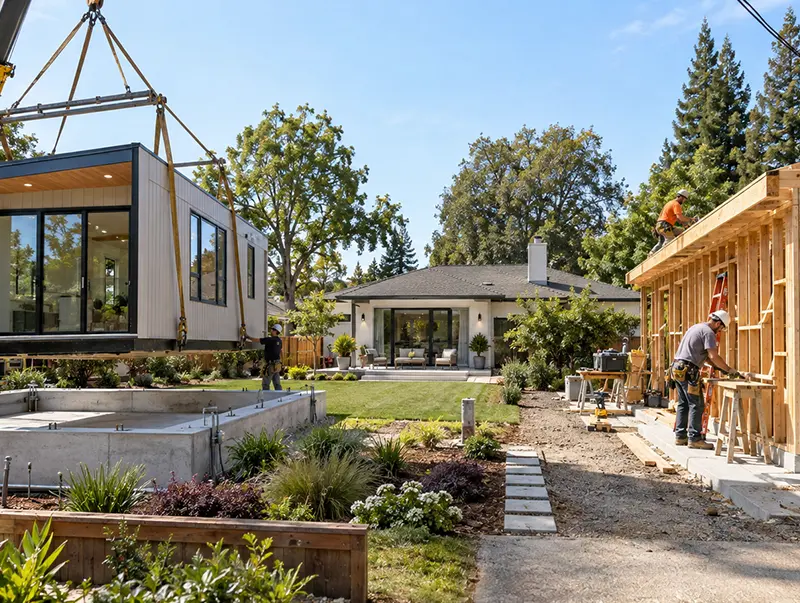
At Global Arch Construction, we are a design-build company. That means we do not treat design and construction as two separate worlds. We look at the project as one complete process: design, engineering coordination, permits, construction, inspections, and final approval. That approach matters because a beautiful project still has to be structurally sound, code-compliant, and approved by the city before it is truly complete.
There is a well-known saying in construction: “building codes are written in blood.” It is a strong phrase, but it reflects a real idea. Over time, many code requirements developed because past failures showed what can happen when buildings are not designed or built correctly.
Today, building codes exist to establish minimum standards that protect public health, safety, and general welfare. In California, those standards are based on Title 24, and the current 2025 California Building Standards Code became effective on January 1, 2026.
For homeowners, this means the city is not asking for inspections just to create extra steps. The inspection process is there to confirm that the work is being done safely, according to the approved plans, and in compliance with the code.
Most of the critical parts of a construction project eventually get covered. Concrete hides reinforcing steel. Drywall hides framing, wiring, and plumbing. Roofing covers structural sheathing and fastening. If those stages are not checked before they are concealed, serious problems can stay hidden until they turn into structural damage, water intrusion, fire risk, or costly corrective work.
That is why cities inspect the work in stages. A typical California residential project may include inspections for the foundation, slab or underfloor work, roof or shear nailing, rough framing, rough plumbing, rough electrical, rough mechanical, insulation, drywall or lath, shower pan, and final completion. A basic rule repeated by local building departments is simple: do not cover the work until it has been approved.
One of the biggest misconceptions homeowners have is that every city follows the exact same building process. That is not true.
California has statewide building codes, but local jurisdictions may adopt amendments when they are reasonably necessary because of local climatic, geological, or topographical conditions. In real construction terms, that means the details and inspection requirements can change depending on where the project is located and what conditions affect the site.
A city may require additional review, different details, or extra documentation because of:
For example, California’s wildfire rules for qualifying areas can add requirements for exterior materials and defensible-space-related approvals, and projects in flood-prone areas may require elevation documentation as part of the inspection path. In very-heavy termite conditions, certain foam-plastic foundation/slab details are also restricted or require protective measures.
That is why one house addition in one city may move differently than another house addition in a different city, even when the layouts look similar on paper.
The exact order depends on the city and the project, but the inspection path usually follows the construction sequence.
This stage is generally done after forms, reinforcing steel, hold-downs, anchor bolts, and related structural items are in place, but before concrete is poured. Depending on the project and jurisdiction, the inspector may also review setbacks, excavation size, soils-related requirements, and other conditions that must be confirmed before the pour. Local California inspection guides also show that flood-zone projects may require elevation documentation at this stage.
This stage usually happens after under-slab or underfloor plumbing, ducting, conduit, and other systems are installed and tested, but before they are covered. For raised-floor construction, underfloor framing, utilities, and access conditions may need to be approved before insulation and subfloor are installed.
Roof sheathing nailing, straps, drag nailing, hold-downs, shear panels, and connectors are often inspected before the work is concealed. On structural projects, these inspections are especially important because they confirm that the shear system and load path match the approved plans.
This is one of the most important stages in the project. At this point, the building is typically dried-in or weather-tight enough for the city to inspect framing, fire blocking, rough trade systems, venting, ducting, grounding, bonding, gas tests, and related code items before insulation and drywall cover the work.
After rough work is approved, the project moves into insulation and wall-covering inspections, followed by final inspection when the building is complete and ready for occupancy. California energy compliance documents may also be required as part of this process, including CF1R, CF2R, and CF3R forms depending on the scope and verification requirements.
Some projects require more than the regular city inspection schedule. These are called special inspections.
Special inspections are typically tied to CBC Chapter 17 and apply to specific structural, engineered, or material-related work. Depending on the project, they may include inspections or testing for foundations, hold-downs, structural framing, reinforcing steel, concrete, welding, shear systems, anchorage, and other engineered items identified on the approved plans. Local California forms make clear that these inspections must be performed in accordance with the approved inspection program and that agencies and inspectors must be recognized by the building official.
Special inspections are usually performed by approved agencies and qualified inspectors. Depending on the scope, those professionals may carry certifications such as ICC, ACI, or AWS/CWI, and agencies may also hold recognized accreditations. The exact approval still belongs to the jurisdiction, not just the certificate itself.
For the homeowner, special inspection is another layer of protection. For the contractor, it is another layer of coordination.
When special inspection is required, the project may need an approved statement of special inspections, qualified agencies on the team, and reports available at the required stages. In practical terms, that means some work cannot move forward until the proper special-inspection documentation is completed and ready for the city or building official.
This is where the design-build approach matters.
At Global Arch Construction, we do not look at a project only as framing, only as finishes, or only as permits. We look at the whole path. That includes the design intent, structural needs, code requirements, inspection sequence, special inspections when required, and how all of that affects the schedule and the construction process.
That is especially important when we build a house addition, handle entire house remodeling, or construct an attached or detached ADU, because these projects often involve structural changes, utility upgrades, energy compliance, shear requirements, and city coordination all at the same time.
We currently have projects in Citrus Heights, Rocklin, Roseville, Granite Bay, San Anselmo, Corte Madera, San Francisco, South San Francisco, Oakland, and Palo Alto. These projects include structural repair, house additions, ADUs, entire house remodeling, balcony repair, tenant improvements, dry rot repair, garage conversions, and bathroom remodeling.
One Citrus Heights project involves structural work after a homeowner previously removed a load-bearing wall without design or permits. Other active projects include an ADU and house addition in Citrus Heights, a house remodeling, addition, and ADU in Rocklin, a commercial tenant improvement project in Roseville, a house addition and elevation lift in Granite Bay, a large addition and remodel in San Anselmo, a second-floor garage addition and roof structure project in Corte Madera, a garage addition with bathroom, bedroom, and deck work in San Francisco, a bathroom remodeling project in San Francisco, a master bathroom and balcony project in South San Francisco, a deck dry rot repair in Oakland, and a balcony repair with structural and water-intrusion issues in Palo Alto.
We mention these projects for one reason: to show that building codes and inspections are not just theory to us. They are part of our daily work. Every project moves together with the code, the plans, the city inspections, and any special inspections required for that specific job.
A good contractor does not only build what is visible. A good contractor prepares what will be inspected.
That means understanding when the foundation is ready, when rough framing can be called, when special inspections are required, when energy documents must be ready, and when a project should wait instead of being covered too early.
For homeowners, this is important because the project is not only about getting from demolition to finishes. It is about getting there the right way. When the work is designed properly, built properly, and inspected properly, the result is safer, stronger, and easier to approve, insure, and live in.
If you are looking for a general contractor who also provides design services, the process matters just as much as the final result.
At Global Arch Construction, we help homeowners and property owners move through the full construction path: design, permits, structural coordination, inspections, special inspections when required, and construction completion. Whether you want to build a house addition, complete entire home remodeling, or create an attached or detached ADU, we are ready to help guide the project in a code-compliant and professional way.
Contact Global Arch Construction today to discuss your project and work with a design-build team that understands how to build it right from the beginning.
From residential remodeling to commercial construction