9.11.2026
What Your Lease Already Decided About Your Build-Out
This is the default text value
This is the default text value
This is the default text value
,
This is the default text value
This is the default text value
Lorem ipsum dolor sit amet, consectetur adipiscing elit. Suspendisse varius enim in eros elementum tristique. Duis cursus, mi quis viverra ornare, eros dolor interdum nulla, ut commodo diam libero vitae erat.
Default Button Text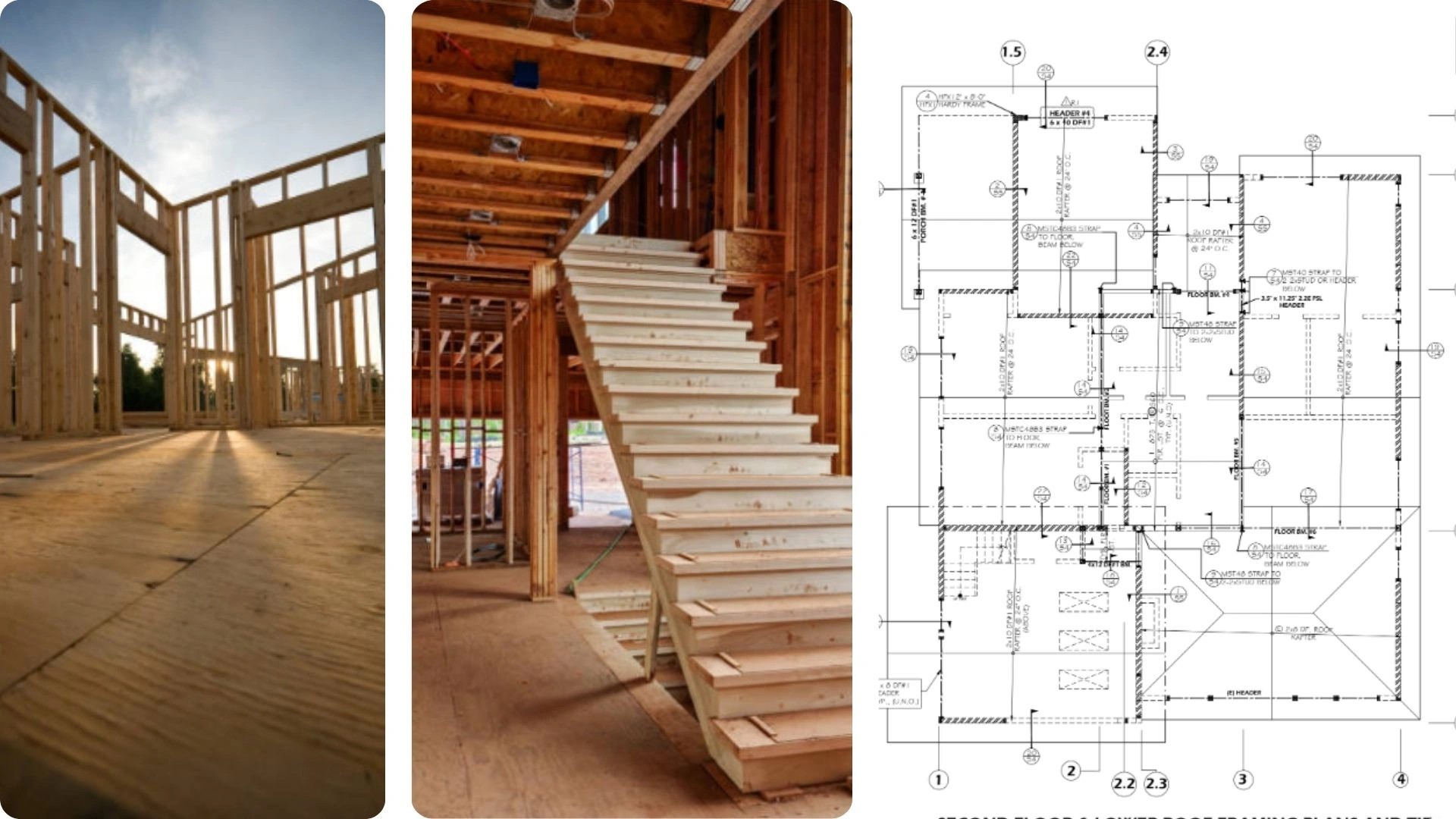
If you are planning a house addition, entire house remodeling, or building an attached or detached ADU, the rough frame inspection is one of the most important stages in the project because this is where the building starts to become a real structure with real rooms, real openings, and real support.
At the foundation stage, the city checks what the project is built on.
At the framing stage, the city checks what the project is becoming.
This is the point where walls, beams, headers, floor framing, roof framing, openings, and structural connections come together. It is also the stage where many important life-safety details are still visible before insulation and drywall cover them.
At Global Arch Construction, we are a design-build company, which means we do not look at framing as just lumber installation. We look at it as part of the full process: design, engineering coordination, permits, construction, inspections, and final approval. That matters because framing affects structure, layout, safety, and how every other trade fits inside the house.
A rough frame inspection is the city’s review of the structural skeleton of the project after the main framing has been completed, but before the work is concealed.
This stage is important because the inspector can still see:
Once the walls are insulated and covered, many of these details are no longer visible.
Framing does more than hold up the building.
It also controls:
That is why rough frame inspection is not just about whether the house is standing. It is about whether the structure is being built safely, correctly, and in a way that works with the rest of the project.
The exact checklist depends on the city, the project type, and the approved plans, but rough frame inspection typically focuses on the overall structural and safety condition of the framed building.
The city may review whether the framing matches the approved plans, including:
This matters because a framing plan is not only about dimensions. It is also about how loads move through the structure.
Framing inspection is also important for things like:
These are life-safety issues, not just finish details.
At this stage, the city may also check details that help slow the spread of fire and smoke, such as:
This becomes especially important in additions, garage conversions, ADUs, and large remodeling projects.
Framing also has to work together with:
A project can have good carpentry and still fail inspection if the framing and trades are conflicting with each other.
Framing inspections are especially important in remodeling because existing homes often come with surprises.
A new house starts from a clear structural system.
A remodeling project often involves:
That is why framing in a remodeling project must be treated carefully. A wall that looks simple may be load-bearing. A new opening may require a different header than expected. A change in one area may affect the load path in another part of the house.
This is one of the reasons we take structural coordination seriously on house additions, entire house remodeling, and attached or detached ADUs.
If the framing is not built correctly or gets covered before the city checks it, the problems can be serious.
Some common issues include:
For homeowners, that can mean delays, corrections, extra cost, and unnecessary stress.
At Global Arch Construction, we deal with this kind of work on real projects across Northern California. Our work includes house additions, attached ADUs, detached ADUs, entire house remodeling, bathroom remodeling, kitchen remodeling, structural corrections, and tenant improvements in cities such as Citrus Heights, Rocklin, Roseville, Granite Bay, Sacramento, Davis, Novato, San Anselmo, Corte Madera, San Francisco, South San Francisco, Oakland, and Palo Alto.
That includes projects involving:
We mention this because framing inspection is not theory to us. It is part of the real work we manage every day.
For homeowners, rough frame inspection should be seen as protection.
It helps confirm that:
A house can look beautiful at the end, but if the framing is wrong behind the walls, the problems may not become obvious until much later.
If you are planning a house addition, entire house remodeling, attached ADU, detached ADU, bathroom remodeling, or kitchen remodeling project, the framing stage should never be treated as just another inspection.
It is one of the stages that defines whether the project is being built the right way.
At Global Arch Construction, we provide design and construction services, and we help homeowners move through design, permits, structural coordination, framing, inspections, and final approval step by step. If you are looking for a contractor who understands the full process, contact Global Arch Construction to discuss your project.
From residential remodeling to commercial construction